

Emotional Zoo
A meltdown should never be the first sign.
In autistic children, published studies find a signal in the body minutes before an episode. Emozu is testing if a soft band with a little friend on top can warn a parent in time, at home.
Research stage. Not a medical device. Not for sale.


The problem
Today a parent finds out by watching it happen.
This started with one family close to us. Then we read what other parents write, and saw the same picture. The child often cannot say what is wrong. The parent looks for a trigger after the fact, and the next one comes without warning.
of 409 parent posts are about hunting for triggers.
Our tagging of public posts, mostly r/Autism_Parenting.
of autistic children have been aggressive toward a caregiver at some point.
of children tried to run away after age 4.
Our idea
A soft band. A little friend on top. Serious sensing inside.
Many children pull a medical sensor off. A friend is different. The friend sits on a band, the band reads the body, and the parent gets a quiet message on the phone. No screen on the child and no alarm in the room.
 Friend: soft top you can swap
Battery lives in the friend
Two hooks, a latch, contact pads
Four spring contacts
Board: motion sensor, soft buzz
Base on the skin: pulse, EDA, temperature
Pebble frame, woven band
Render · design targets
- Heart rate and HRV
- Skin conductance, EDA
- Skin temperature
- 3-axis motion
- Battery in the friend
- No screen, ever
In a 2025 survey of 40 parents of nonverbal children, 67.5% supported a wearable stress detector (Weber et al.).
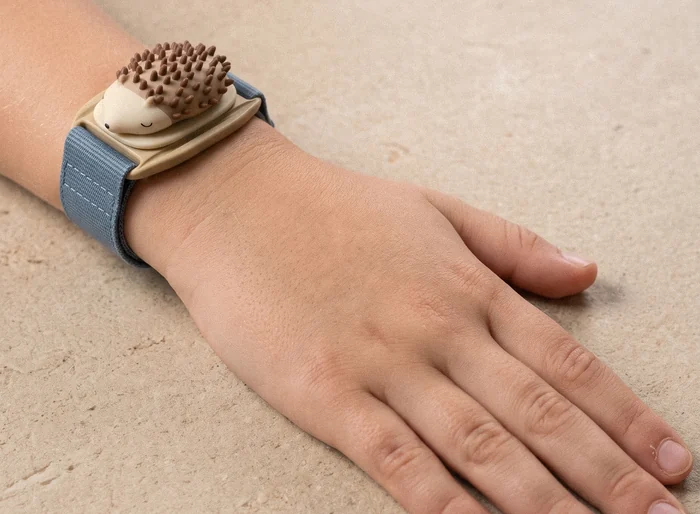
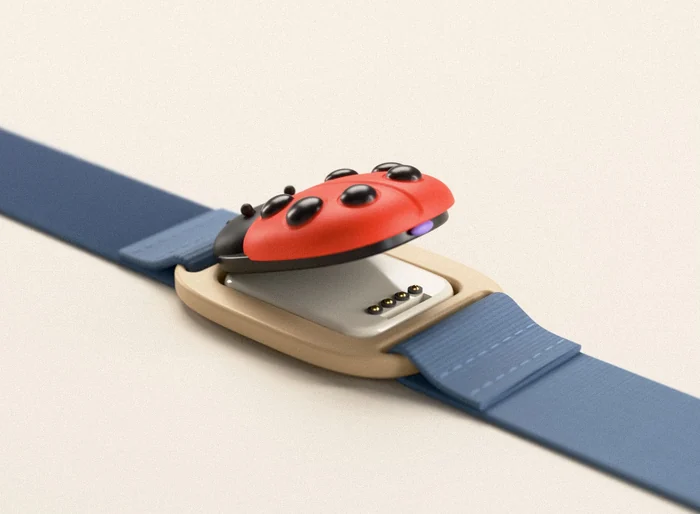
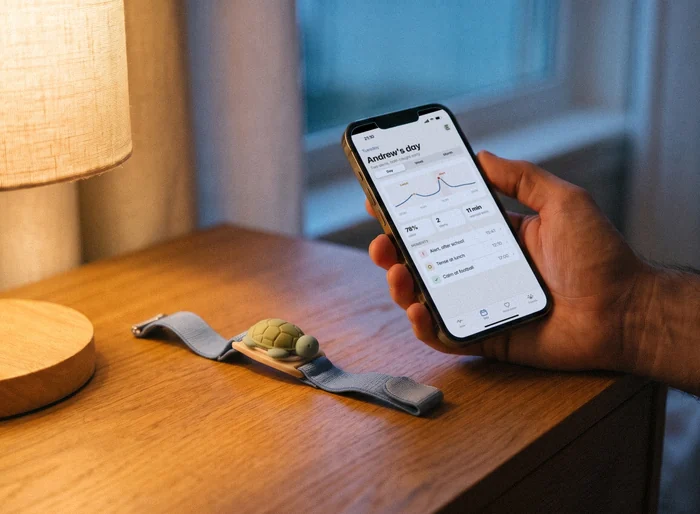
 Render
Three friends. One band.
Hedgehog, ladybug, turtle. Soft silicone tops, a soft TPU frame, a woven band. Each friend carries its own battery, so a child can swap friends and keep the band on. At home, friends rest and charge in the Zoo.
Parent app
Warn me, show me the day, tell me what actually helps.

The alert
Minutes before, not after.

The day
Patterns nobody can hold in their head.

What works
Ranked by the body, not by guesswork.
Concept screens with invented data. Nothing here is a working product yet.
What it is based on
The body changes first. That can be measured.
Four studies from 2019 to 2026 use a wearable sensor to catch an episode. Three of them predict it, 1 to 10 minutes ahead. The models look for this: heart rate goes up, heart rate variability goes down, and skin conductance bursts come more often.
Minutes before the episode. Curves are illustrative. The window comes from Imbiriba 2023 (3 min) and Kartha 2026, preprint (10 min).
ahead, AUROC 0.80, in 70 young people across 4 hospitals.
ahead, AUROC 0.78, in 9 young people in a special-ed class. The sensor sat on the ankle.
of the 99 children in these studies were followed at home.
Hospitals, clinics and classrooms only.
The hard part: about 2 of 3 alerts were false.
A parent who gets pulled away for nothing stops listening. So we do not start with alerts. We start silent: record, label, and look back. “Yesterday at 16:40 it began eight minutes before you noticed” has no false alarms at all. Live alerts come later, and only if the numbers hold.
The gap
99 children in the literature. None of them at home.
Home is where a parent needs the warning most. The research devices the models were trained on left the market: Q-Sensor in 2013, Empatica E4 in 2025.
Goodwin 2019 20
hospital unit
Imbiriba 2023 70
4 psychiatric hospitals
Kartha 2026 9
special-ed class
At home
labeled episodes
Roadmap
Where we want to be in 6 to 9 months.
A paper with clinical psychiatrists, on 30 to 50 children, with prototypes we produce ourselves. This is a plan, not traction. Investors: write to us for the one-pager.
Running at home on an off-the-shelf device with the sensor we need. Worn all day, raw signal, labels. About 15 episodes. The question: can we warn ahead, at home?
Six families are ready, from a parent community of 135 families. Same protocol, more children.
A scientific advisor turns pilot data into a protocol. Ethics, consent, data rights. FDA Pre-Sub before any claim.
Our own small batch of bands that give raw signal and that children keep on. Research devices are gone from the market.
With clinical psychiatrists, on 30 to 50 children, by protocol. Then the package for a round.
Open questions we still have to answer: who pays, medical device or wellness, and what the alert threshold should be.
FAQ
Short answers.
What is Emozu?
A research project. We test whether a soft band on the wrist of an autistic child can warn a parent minutes before a meltdown, at home.
Is it a medical device? Can I buy one?
No. Emozu is at the research stage. It is not a medical device, it does not diagnose or treat anything, and it is not for sale.
How can a band know a meltdown is coming?
Published studies see the body change 1 to 10 minutes before an episode: heart rate, skin conductance (EDA) and motion. A model learns that pattern and sends a quiet message to the parent.
What does the band measure?
Heart rate and HRV, skin conductance (EDA), skin temperature and 3-axis motion. There is no screen on the child and no alarm in the room.
How accurate is it?
Published models reach AUROC 0.71 to 0.87, where 0.5 is a coin flip. The one study that reports alerts found about 2 of 3 were false. So we start silent: record, label, look back. Live alerts come only if the numbers hold.
Why a little friend on top?
Many children pull a medical sensor off. A friend they like is easier to keep on. The friend also holds the battery, so a child can swap friends and keep the band on.
How can my family join?
Right now the pilot is closed: one child at home. Next come six families from a parent community of 135. Write to us through the form. The form is for adults, and please do not send medical details there.
I am a clinician, researcher, engineer or investor.
Write to us. We are looking for clinical psychiatrists for the study, hardware and signal engineers for the prototype, and investors for our pre-seed round.
For parents
- Can you see a meltdown coming? What to watch in the hours and minutes before
- How to keep a meltdown trigger diary, and use AI to read it
- Why autistic kids take wearables off, and what helps them keep one on
- Sleep and meltdowns in autistic children: what research says, and what to track
- When a child runs: autism, wandering and what actually helps
- When your child can't tell you they're thirsty: communication without words
Write to us
One button. Tell us who you are and what you have.
We need people who can turn a pilot into science and a product. Investors, clinicians and psychiatrists, hardware engineers, research groups, families. Write a line, drop a link, or attach a file.
Yury, the founder, reads every message.
Prefer email? [email protected]